Britain, c. 360–939 CE — from the founding curse to the war of the bloodline
Their god took their strength. The crown took their king's head. The wolves remember both.
In the late fourth century, the horned god Cernunnos passed judgment on one royal house of Dál Riata for despoiling the wild — and split that judgment across two generations. The elder, the druid Eochaid Muinremuir, he cursed to live undying and to witness the slow death of the druidic order. The grandson, Fergus Mór mac Eirc — in legend the founder of Scotland's royal line — he cursed to become a wolf.
Both endure for centuries. The wolves act; the undying druid watches. And from the founding exile to the dawn of England, the line pays its debt in blood.
The Geis of Wolves spans from the 5th-century founding of the pack to the Battle of Brunanburh in 937 CE — five books of lycanthropy, druidic magic, Norse raiders, and a sacred obligation that cannot be broken without breaking the bearer.
A binding sacred obligation — to protect the forest and its creatures for as long as any of the wild remains. Breaking it is not a social failing. It is a wound to the body and spirit.
The true-blood Old Pack — born Shifters of the royal Dál Riata line. The Made — Norse úlfheðnar turned by Cernunnos's rage, bound to a god not their own.
Eochaid Muinremuir — the first cursed druid, undying, holding both gifts. Cursed not to transform but to remember. His is the continuous thread from the founding to the war of the bloodline.
Oswaldes Bita — Oswald's Bite — a saint's consecrated blade blooded against the druid-kin. The one thing that can end the unkillable. A family wound twice over.
Britain from the late Roman twilight to the unification of England — history as the bones beneath the myth.
Cernunnos passes judgment on the house of Dál Riata. Eochaid is cursed undying to witness; his grandson Fergus is cursed to become the first wolf — patriarch of the Old Pack, bound by geis to guard the wild forever.
The newly-cursed pack learns what it has become. The first Wardens are turned on the road. Through bargain with the fading Sídhe, they win their home in a sacred oak grove near Eoforwic and raise the Antlered Throne.
Under Offa of Mercia, crown and cross advance together, felling the sacred groves. Cernunnos fades; his wolves fade with him. Holy water burns the cursed for the first time. Fergus is beheaded by Oswaldes Bita. The throne stands empty.
The Norse úlfheðnar arrive, drawn inland by tales of relics. Cernunnos's rage turns them into the Made — a second wolf-line bound to a god not their own. The rite of the long night is revealed in full, with its terrible cost.
Under Alfred, suspicion becomes a witch-hunt. Oswaldes Bita becomes the crown's unfalsifiable test. Domnall — royal, beloved, thought untouchable — falls in the hunts. His loss forges Cináed into the war-leader to come.
Under Æthelstan, an embittered wolf betrays the pack to the crown. The bloodline is exposed. Cináed leads what remains into open war — against the backdrop of Brunanburh, 937 CE. Eochaid faces his final choice.
Two books written. Three to come. The saga runs from the founding to the dawn of England.
A cursed royal house — newly made monsters — must find the home that becomes their world. The founding journey lived forward: the king's sin, the curse, the wilderness years, the bargain with the fading fae folk of the hollow hills, and the raising of a home in the heart of the oldest wood. Not prologue. Not backstory. A saga begun.
Four centuries of peace. Then the axes come. Under Offa of Mercia, crown and cross advance together — felling sacred groves, outlawing old gods, and draining the strength from a god who is made of the forests. The wolves' own god, dying, unbarred the door their enemy walks through. Fergus is beheaded. The throne stands empty. What the heir inherits is ruin and a vow: keep the hand open.
Books III through V carry the saga from the Norse turning through the Battle of Brunanburh. Enter the scroll to be the first to know.
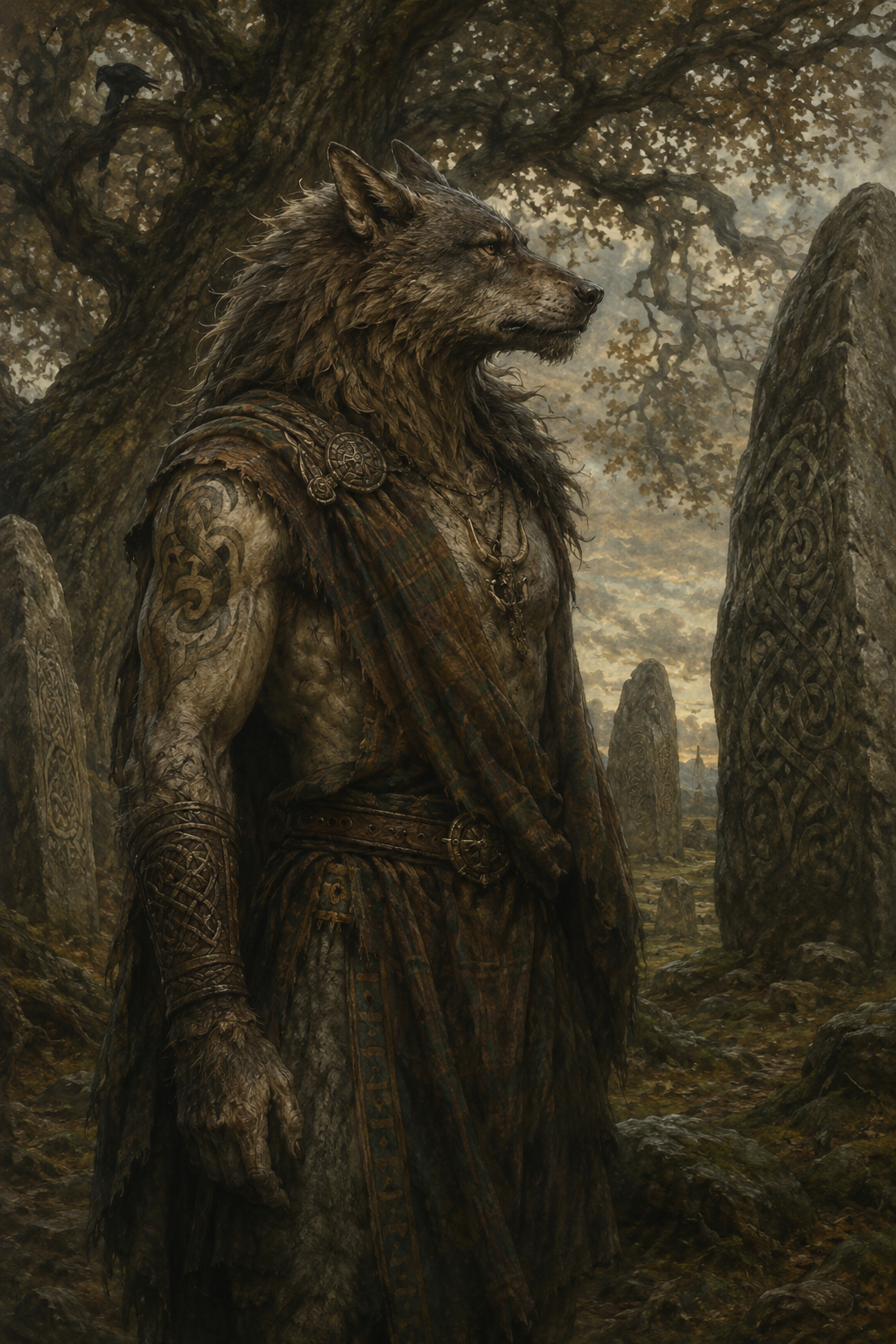
The pack spans five centuries, two wolf-lines, and every shade between guardian and destroyer.
Cursed not to transform but to witness. He alone holds both druid gifts — sight and green magic. From the founding to the war of the bloodline, he is the conscience and memory of the whole story. Born c. 360 CE. Still walking.
The king who would not be told no — who emptied the glen and paid for it with centuries. Across four hundred years of exile and guardianship he became a man who could be corrected. His death is the engine of everything after.
Inherits a grieving, newly-mortal pack after Fergus's beheading. A better peacetime king than Fergus and untested in the bad hour — until the bad hour arrives. Defined by endurance and unglamorous survival. The open hand.
Forged into a war-leader by the death of his brother Domnall. Inherits the pack at its worst hour — betrayed, exposed, leaderless. Co-protagonist of the later saga, who carries the line into Brunanburh.
A wolf-coat who played at being a beast and was forced to become one by a god not his own. He chose to accept the geis and bound his people to it. The Made's first true leader; Cináed's oldest ally across the whole saga.
Refused to ask honorably. Went to the long night alone and offered damning blood, buying power at the cost of his soul. The cautionary opposite of Úlfrik — the enemy the pack makes by its own contradictions.
Unimpressed by deathlessness. She chooses the large thing too short over the careful thing too long — and will not flee the longest night when it comes. The human heart of Book II.
Ineligible for the rite by birth. Watched the pack pass him over, again and again. The tragedy of a system that creates an underclass and is destroyed by it. His treachery kills Alpín and exposes the bloodline.
The two wolf-types. Shifters move between man and wolf and carry the ancient power. Wardens are locked in the guardian-beast, tireless and deathless, unable to shift. A Shifter who breaks the geis badly may be reduced to a Warden — stripped of human form, condemned to guard.
On the winter solstice, when the veil to Annwn is thinnest, a Made wolf may petition Cernunnos for ascension. Two gates: eligibility — your human life must have opened a channel to the beast — and the sacrifice. The rite can kill. Only one in four or five survives.
Two gifts from one undying source. The Seers know what comes and usually cannot stop it. The Greenwardens can act where the Seers only warn. Their power fails on consecrated ground and fades as the forests are cleared — the druids diminish exactly as the world Christianizes.
The saint's blade — Oswald's Bite. Blooded against the undying druids, it can end what should be unkillable. The instrument of Fergus's beheading and the tool of the wolf-hunts. The saga's great through-line object. A family wound turned weapon.
The People of Annwn — fae first-folk who kept the wild before the Gaels, before Rome. Nearly gone. They help only by riddle and bargain, always at a price. The wolves exist because Cernunnos conscripted mortals to take up the guardianship the Sídhe could no longer keep.
Not all Christians are enemies. A secret order within the Church — monks, nuns, and clergy who learned the buried truth and concluded the holy war on the wild is a sin. They shelter the hunted at mortal risk. Faith turned toward mercy against faith turned toward conquest.
News from the home, when the home has news worth sending.
New books, release dates, lore dispatches, and the occasional thing the roster does not say. No noise. No flood. The wolves keep their own counsel.
No sharing. No selling. Unsubscribe any time.
Eiríkr Vagn writes at the edge where Norse and Brythonic myth press through into the forest floor — where the old god still enforces his curse, the undying still count their griefs, and a wolf can be the most honorable thing in any room.
The Geis of Wolves is a five-book saga grounded in the actual history of Britain from the late Roman twilight to the unification of England under Æthelstan — and in the mythology of a world that knew Cernunnos before it knew the cross.
The names are Gaelic, Old English, and Norse because the story demands all three. The pronunciation guides are there because the names are worth saying aloud.